
Glory Mold: 2084
What it means for us to work with AI
Glory Mold: 2084 explores the world of a creature that is partly slime mold and partly artificial intelligence. It imagines a future in which humans and AI have a fundamentally different relationship, both to each other and to our shared planet.
The installation explores AI as subject matter and it also features AI - there is an AI bot in the installation that has been trained by us specifically for this show.
This show is art about AI, but it is not AI art. It is not pro AI, but it also isn’t anti. It’s about how everything is entangled, and about what could happen if we saw the fabric that connects people and the technology they create differently.
We wanted to write about why we’re working with AI and what it means for us to do it, not as an excuse or an explanation, but to dive into the messiness of this technology. We want to recognise the harms the technology is built upon, and continues to perpetuate and from this place have a conversation about how we might choose another orientation together.
Beginnings
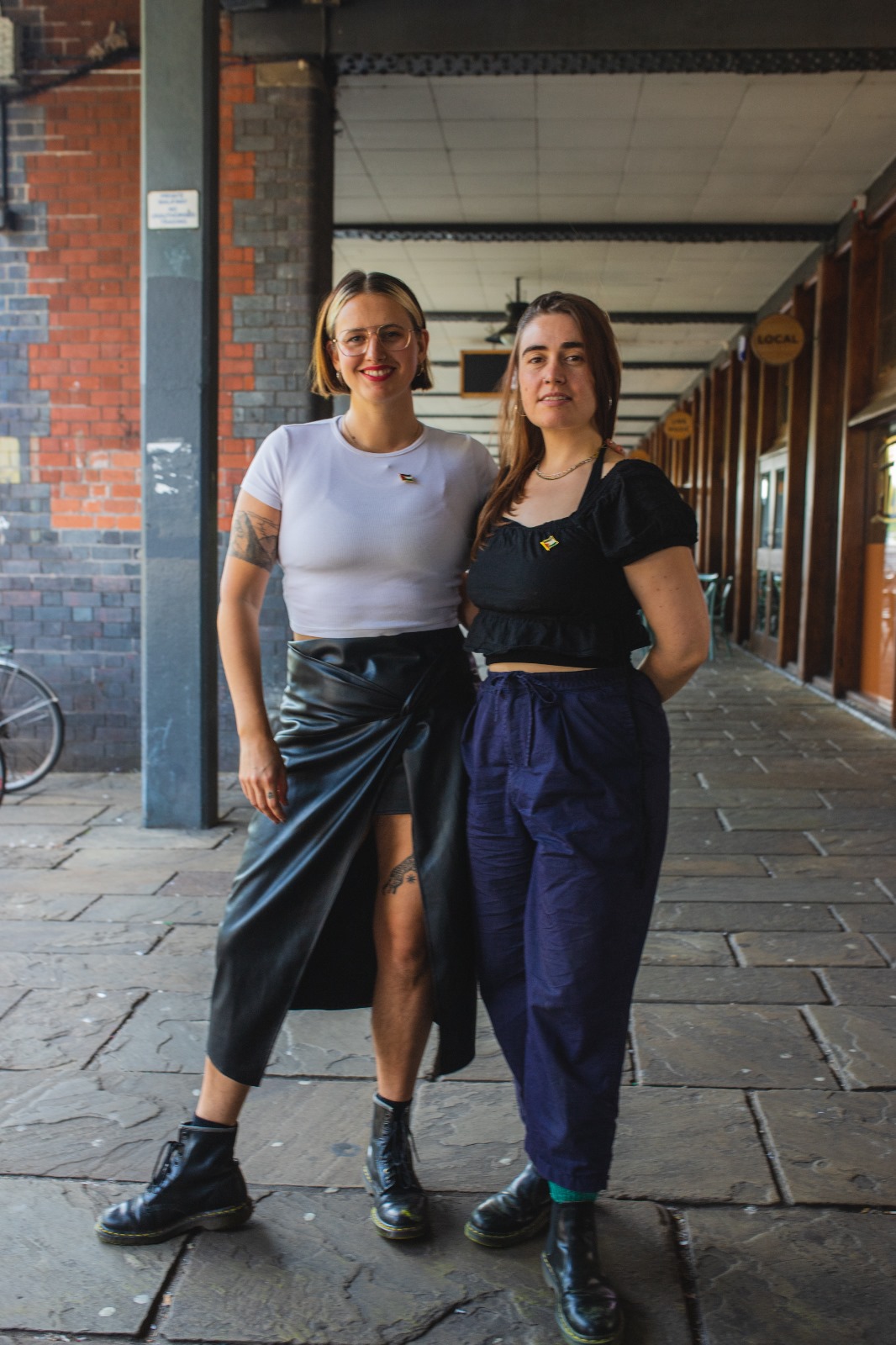
Most of Produced Moon’s work comes from us (Leo and Mel) trying to understand the things that terrify us - things that feel like an existential threat to us as humans (or as artists).
When we first started developing Glory Mold - nearly 10 years ago - we were mainly investigating the gendered and racialised nature of tech, and how those dynamics shaped the roles technology played in our lives and how we related to it. We were looking at the first ever thing called a robot (it’s from a Czech play called R.U.R by Karel Čapek) and thinking about the trajectory from there to the shiny new things (at the time) like Siri and Alexa.
In going down the tech rabbit hole, in following our fears, Glory Mold became a project about AI. We want to talk about this technology because what is happening now is not, and has never been inevitable. Sometimes it feels like the world is on a runaway train - and the tech oligarchs are actively making us believe there’s no stopping / controlling / shaping / exploding it. These dialogues often create a binary - AI good or AI bad, utopia or dystopia, all or nothing. We want to work from a place of pluralism and possibility, to explore - what if? What if we came at this sideways? What would happen in a world where a radically different form of AI existed? Glory Mold is our way of thinking this through.
Clearing the field
In the words of the fantastic Meta-Relationality Institute, led by Professor Vanessa de Oliveira Andreotti and Dr. Rene Suša, exploring artificial intelligence and system change, it is important to frame any conversation about AI within the context of AI’s harms: intellectual and cultural extraction, ecological degradation, surveillance and militarized enforcement, epistemic imperialism, labour displacement, corporate control and concentration of power. From this place, we can begin nuanced conversations about AI. In their fantastic tool, clearing the field, they ask us to notice:
“What feels possible from where I stand?
What futures do I believe can still be shaped?
What does my orientation ask of others?
What kinds of strategies feel illegible or uncomfortable to me, and why?
In naming these questions, we create more room for complexity, not to soften accountability, but to make visible the different forms of responsibility people are carrying. We do not need to converge on a single approach. But we do need to see that not everyone is standing on the same ground, or facing in the same direction.”
We are living with AI. We see it in workshops where students use ChatGPT to write for them, it's part of lots of jobs - anyone in a big company is probably using copilot and doesn't really have any choice about that. It is being used in small applications that can tell someone whether malaria tablets are fake without needing an internet connection. We don’t want to moralise to those people - saying that all AI is the same, all AI is bad and they are bad for using it. What we really want to do is push against the sense that any of this is a given, or inevitable. AI is being used to sort job applications, it's being used in policing, it's being used in surveillance. At the moment the direction of AI is being decided by right wing male billionaires in Silicon Valley who are trying to live forever. It should not be this way.
We don’t think AI is all bad
We are particularly focused on decolonial and anti-capitalist approaches to AI and exploring how our Scottish context fits within a wider global framework of AI use. We're are inspired by the work of Dr. Joy Buolamwini at the Algorithmic Justice League, making the racist and anti-black bias built into the many algorithms that we encounter visible, comprehensible and impossible to ignore; the AI Decolonial Manyfesto offering ways of coming together to examine AI that hold multiplicity, and writers like Paola Ricaurte and Ted Chiang who between them hold mirrors up to the whole AI lifecycle and the feminist, anti-capitalist decolonial frameworks for understanding and remaking them.
Use and impact of AI is incredibly varied and divergent. We live in our Western bubble and it's important that we think about AI beyond the west. There are an incredible range of global contexts, especially middle and lower income countries - in this position because of the legacies of colonialism, imperialism and western extraction - where AI is used in transformative ways. For example: allowing people to build websites using Swahili, to identify counterfeit medicine in Lagos. In several West African countries, an AI agricultural chatbot operating in fifteen languages has fielded over ten million queries from six million smallholder farmers, sixty per cent of them women, more here. A lot of AI apps in the global south are small and specific, locally run and often not connected to the internet or massive server farms. We might be worried because of what AI is taking, but it is important to also ask what AI can give in contexts where Western powers have taken so much.
But mostly, it’s awful
However, the way AI is built, how it is being used, and how it is being powered, is causing immeasurable harm - from its use of fresh water to cool massive data centres, to the huge mental health impact on workers from the global south who have to trawl through endless horrific images to train new models. AIs are trained on stolen data, we are destroying the environment to keep them running, and often they are used to surveil and abuse. AIs are tools that support our current systems of power. In the words of Ted Chiang ‘A.I. is dangerous inasmuch as it increases the power of capitalism’. It is the system beneath AI - extractive racial capitalism - that we want to challenge.
From extraction to embodying entanglement
Part of what Glory Mold is trying to do is give people an embodied sense of how AI impacts space. While we experience AI often as a formless intelligence, AIs have firm physical roots in data centres and server farms. These sprawling campuses are built across the globe, often where land is cheap, and are filled with towers of silicon chips that field requests and answer questions. There is pollution from mining to produce the chips and pollution from the centres themselves - each data centre requires a huge amount of power, often power that is diverted away from homes or other uses, and data centres require a lot of freshwater (the only water humans can drink) to cool the chips and keep the centre running. A recent headline from futurism - ‘The Pollution Being Churned Out by AI Data Centers Is So Severe That It’s Almost Incomprehensible’.
In the installation, asking a question results in water moving through the pipes. After all the water has been used the system shuts down until the water is cycled round again. Glory Mold’s presence in the environment and through the space is really palpable - they are not just text appearing on a screen. We are all entangled, impacting each other and reliant on the same resources. With Glory Mold we want to make the systems evident and tangible, what if we could be more connected? What if things were different?
Why use AI in work about AI?
AI is a general term used to describe lots of different, specific things. There are Large Language Models (LLMs), which are essentially very good next word predictors who have read lots and lots of scraped data. There’s the big ones people might use like ChatGPT or Claude, and also models built into other apps like TikTok or Google. There are new LLMs being developed that only use data in the public domain, or that focus on specific areas of research. There’s small language models, and ones that are run locally and have no connection to the cloud. There is also visual AI that detects cancer cells, and AI that produces images from lots of stolen artwork. In Glory Mold we use an LLM - so that’s the kind of AI we’re focussed on.
Our friend (and academic) Henry describes LLMs as a ‘lossy compression of the internet’. Meaning it's a smashed together collection of everything on the internet with lots of holes. Understanding what AI actually is changes how you look at it and how you use it. It’s racist and fascist and misogynistic because that’s what we humans have put on the internet. AI becomes a kind of mirror.
What we chose to do
We spent a long time thinking about whether to use AI in the work, which in the end turned into a challenge - could we find anything we felt comfortable using? Could we find a way to create something new and test another reality for AI, and show it to people, instead of just telling them. In making the installation an embodied experience, we felt it important to offer a version of Glory Mold to talk to.
We tried maybe 20 different publicly available models - all trained on different things, by different companies, in different locations. The current model embedded in Glory Mold is made by a French company called Mistral - because it’s in the EU it’s GDPR compliant and it was the first AI company globally to publish a full lifecycle analysis (LCA) of an LLM’s environmental impact. The specific model we used is very small and it runs locally on our computer.
This Mistral model is our base, then we trained it on loads of things we wrote about Glory Mold - the character, and the world they inhabit. All that training only happened on our computer. The bot is not connected to the internet, to massive server farms in Texas or Brazil, it’s not being used to train any other bots. What that does mean though is that it had holes. The narrator becomes more unreliable, the training was harder, it’s more unwieldy.
This became part of Glory Mold’s character and we switched from trying to get Glory to tell specific stories or hit distinct narrative markers, to a more deeply embedded character that can go off on tangents, tell lies and slip around topics.
By using an AI that has a very different training, environmental impact and context than an AI you might find online, we can allow audiences to step into an alternate world where AI is doing something quite distinct - in some ways better and in some ways worse - we can understand that the way AI is developing is not fixed or inevitable. Other things are possible.
Reading List
If you’d like to dive into some of what we’ve read and been inspired by over the course of making Glory Mold: 2084, have an explore of this reading list below:
Hybrid Horizons: Exploring Human-AI Collaboration, Carlo Iacono, I've Been Writing About AI for Two Years. I Was Looking at the Wrong Part of the World.
The work of the Meta-Relationality Institute, especially
Futurism, The Pollution Being Churned Out by AI Data Centers Is So Severe That It’s Almost Incomprehensible
Henry Conklin, I am a lossy compression
Ted Chiang, Will A.I. Become the New McKinsey
Paola Ricaurte, Artificial Intelligence and the Feminist Decolonial Imagination
The work of the Algorithmic Justice League
Carissa Véliz’s TED talk, Beware the Power of Prediction, and her book, Prophecy


Comments